The Human Eye and the Colourful World Class 10 Physics Questions & Answers
मानव नेत्र तथा रंगबिरंगा संसार
Bihar Board/NCERT Class 10 Physics, Chapter 11: objective (MCQ) and subjective (short and long answer) questions with answers.
31
Question 31
Presbyopia arises due to which of the following?
जरादूरदृष्टिता (Presbyopia) निम्नलिखित में से किसके कारण उत्पन्न होती है?
a
Excessive curvature of the cornea
कॉर्निया/स्वच्छ मंडल की अत्यधिक वक्रता
b
Elongation of the eyeball
नेत्र गोलक का लंबा हो जाना
c
Gradual weakening of ciliary muscles and diminishing flexibility of the eye lens
पक्ष्माभी पेशियों का क्रमिक कमज़ोर होना और अभिनेत्र लेंस के लचीलेपन में कमी
d
Increase in the power of the eye lens
अभिनेत्र लेंस की क्षमता में वृद्धि
Ans english:-
Presbyopia arises due to the gradual weakening of the ciliary muscles and the diminishing flexibility of the eye lens with age. As a result, the eye loses its ability to adjust its focal length (accommodation), and nearby objects can no longer be seen clearly.
Ans hindi:-
जरादूरदृष्टिता (Presbyopia)पक्ष्माभी पेशियों के क्रमिक कमज़ोर होने और आयु के साथ अभिनेत्र लेंस के लचीलेपन में कमी के कारण उत्पन्न होती है। इससे नेत्र अपनी फोकस दूरी को समायोजित करने की क्षमता (समंजन) खो देता है और पास की वस्तुएँ स्पष्ट रूप से नहीं दिखती।
Tap an option to reveal the answer
32
Question 32
A person suffering from both myopia and hypermetropia should use _________.
निकट दृष्टि दोष और दूरदृष्टि दोष दोनों से पीड़ित व्यक्ति को _________ का उपयोग करना चाहिए।
a
Only concave lenses
केवल अवतल लेंस
b
Only convex lenses
केवल उत्तल लेंस
c
Bi-focal lenses
द्विफोकसी लेंस (Bi-focal lenses)
d
Plane glass lenses
समतल काँच के लेंस
Ans english:-
Sometimes, a person may suffer from both myopia and hypermetropia. Such people often require bi-focal lenses. A common type of bi-focal lens consists of both concave and convex lenses. The upper portion consists of a concave lens for distant vision, and the lower portion is a convex lens for near vision.
Ans hindi:-
कभी-कभी कोई व्यक्ति निकट दृष्टि दोष और दूरदृष्टि दोष दोनों से पीड़ित होता है। ऐसे लोगों को अक्सर द्विफोकसी लेंस (bi-focal lenses) की आवश्यकता होती है। एक सामान्य प्रकार के द्विफोकसी लेंस में अवतल और उत्तल दोनों लेंस होते हैं। ऊपरी भाग में अवतल लेंस दूर की दृष्टि के लिए होता है और निचला भागउत्तल लेंस पास की दृष्टि के लिए होता है।
Tap an option to reveal the answer
33
Question 33
In a bi-focal lens, which part facilitates distant vision?
द्विफोकसी लेंस में दूर की दृष्टि किस भाग द्वारा सुगम होती है?
a
The lower part (convex lens)
निचला भाग (उत्तल लेंस)
b
The upper part (concave lens)
ऊपरी भाग (अवतल लेंस)
c
The central part (plane glass)
मध्य भाग (समतल काँच)
d
Both parts equally
दोनों भाग समान रूप से
Ans english:-
In a bi-focal lens, the upper portion consists of a concave lens which facilitates distant vision (corrects myopia). The lower portion is a convex lens which facilitates near vision (corrects hypermetropia). This design allows a person suffering from both defects to use a single pair of glasses.
Ans hindi:-
द्विफोकसी लेंस में ऊपरी भाग में अवतल लेंस होता है जो दूर की दृष्टि को सुगम बनाता है (निकट दृष्टि दोष ठीक करता है)। निचला भागउत्तल लेंस होता है जो पास की दृष्टि को सुगम बनाता है (दूरदृष्टि दोष ठीक करता है)। यह डिज़ाइन दोनों दोषों से पीड़ित व्यक्ति को एक ही चश्मे से काम चलाने देता है।
Tap an option to reveal the answer
34
Question 34
The angle between the two lateral faces of a prism is called the _________.
प्रिज़्म के दो पार्श्व फलकों के बीच के कोण को _________ कहते हैं।
a
Angle of incidence
आपतन कोण
b
Angle of deviation
विचलन कोण
c
Angle of the prism
प्रिज़्म कोण
d
Angle of refraction
अपवर्तन कोण
Ans english:-
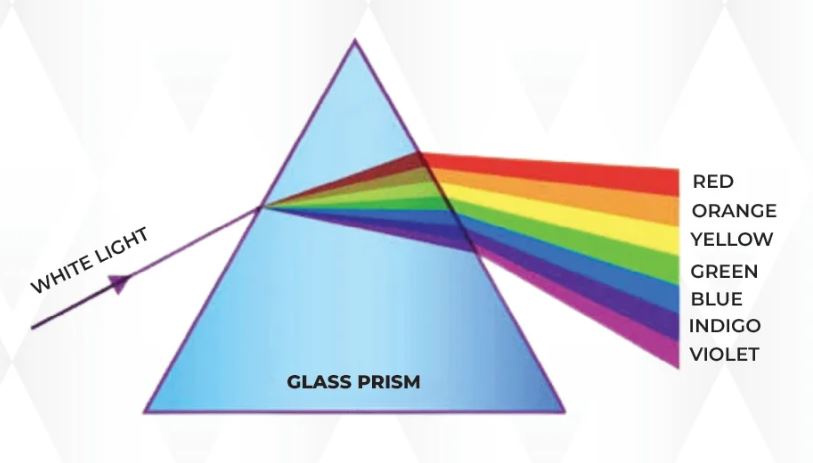
The angle between the two lateral faces of a prism is called the angle of the prism. When white light passes through a prism, it undergoes refraction at both surfaces and the different colours bend by different amounts. This causes the dispersion of white light into its component colours (VIBGYOR).
Ans hindi:-
प्रिज़्म के दो पार्श्व फलकों के बीच के कोण को प्रिज़्म कोण कहते हैं। जब श्वेत प्रकाश प्रिज़्म से होकर गुज़रता है, तो यह दोनों सतहों पर अपवर्तन से गुज़रता है और विभिन्न रंग अलग-अलग मात्रा में झुकते हैं। इससे श्वेत प्रकाश का उसके घटक रंगों (VIBGYOR) में वर्ण विक्षेपण होता है।
Tap an option to reveal the answer
35
Question 35
VIBGYOR represents the seven colours of white light in order. What does each letter stand for?
VIBGYOR श्वेत प्रकाश के सात रंगों को क्रम में दर्शाता है। प्रत्येक अक्षर किसके लिए है?
a
Violet, Indigo, Blue, Green, Yellow, Orange, Red
बैंगनी, जामुनी, नीला, हरा, पीला, नारंगी, लाल
b
Violet, Ivory, Brown, Grey, Yellow, Olive, Red
बैंगनी, आइवरी, भूरा, धूसर, पीला, जैतूनी, लाल
c
Violet, Indigo, Blue, Grey, Yellow, Orange, Rose
बैंगनी, जामुनी, नीला, धूसर, पीला, नारंगी, गुलाबी
d
Vermilion, Indigo, Blue, Green, Yellow, Orange, Red
सिंदूरी, जामुनी, नीला, हरा, पीला, नारंगी, लाल
Ans english:-
VIBGYOR stands for:
Violet, Indigo, Blue, Green, Yellow, Orange, Red.
These are the seven colours of the visible spectrum obtained when white light is dispersed by a prism. Violet bends the most and Red bends the least during dispersion.
Ans hindi:-
VIBGYOR का अर्थ है:
Violet (बैंगनी), Indigo (जामुनी), Blue (नीला), Green (हरा), Yellow (पीला), Orange (नारंगी), Red (लाल)।
ये प्रिज़्म द्वारा श्वेत प्रकाश के विक्षेपण से प्राप्त दृश्य वर्णक्रम के सात रंग हैं। विक्षेपण में बैंगनी (Violet) सबसे अधिक और लाल (Red) सबसे कम झुकता है।
Tap an option to reveal the answer
36
Question 36
The splitting of white light into its component colours is called _________.
श्वेत प्रकाश का उसके घटक रंगों में विभाजन _________ कहलाता है।
a
Reflection
परावर्तन
b
Refraction
अपवर्तन
c
Scattering
प्रकीर्णन
d
Dispersion
वर्ण विक्षेपण
Ans english:-
The splitting of white light into its component colours is called dispersion. When white light passes through a prism, each colour bends by a different angle due to having a different wavelength, producing a band of seven colours: VIBGYOR. This band of colours is called the spectrum of white light.
Ans hindi:-
श्वेत प्रकाश का उसके घटक रंगों में विभाजन वर्ण विक्षेपण (dispersion) कहलाता है। जब श्वेत प्रकाश प्रिज़्म से होकर गुज़रता है, तो प्रत्येक रंग अलग-अलग तरंगदैर्ध्य होने के कारण अलग-अलग कोण से झुकता है और सात रंगों की एक पट्टी बनती है: VIBGYOR। इस रंगों की पट्टी को श्वेत प्रकाश का वर्णक्रम (spectrum) कहते हैं।
Tap an option to reveal the answer
37
Question 37
The band of the coloured components of a light beam is called its _________.
प्रकाश पुंज के रंगीन घटकों की पट्टी को उसका _________ कहा जाता है।
a
Reflection
परावर्तन
b
Spectrum
वर्णक्रम/स्पेक्ट्रम
c
Refraction
अपवर्तन
d
Dispersion
वर्ण विक्षेपण
Ans english:-
The band of the coloured components of a light beam is called its spectrum. When white light is dispersed into its constituent colours, it forms a continuous band known as the spectrum. The visible spectrum consists of seven colours represented by VIBGYOR.
Ans hindi:-
प्रकाश पुंज के रंगीन घटकों की पट्टी को उसका वर्णक्रम (Spectrum) कहा जाता है। जब श्वेत प्रकाश अपने घटक रंगों में विभाजित होता है, तो यह रंगों की एक सतत पट्टी बनाता है जिसे वर्णक्रम/स्पेक्ट्रम कहते हैं। दृश्यमान वर्णक्रम में VIBGYOR के सात रंग शामिल होते हैं।
Tap an option to reveal the answer
38
Question 38
The blue colour of the sky is caused by _________.
आकाश का नीला रंग _________ के कारण होता है।
a
Dispersion of sunlight by raindrops
वर्षा की बूँदों द्वारा सूर्य प्रकाश का विक्षेपण
b
Reflection of blue ocean water
नीले महासागर के जल का परावर्तन
c
Scattering of light by fine particles in the atmosphere
वायुमंडल में सूक्ष्म कणों द्वारा प्रकाश का प्रकीर्णन
d
Absorption of all colours except blue by the atmosphere
वायुमंडल द्वारा नीले को छोड़कर सभी रंगों का अवशोषण
Ans english:-
The blue colour of the sky is caused by the scattering of light by fine particles in the atmosphere. When sunlight passes through the atmosphere, the fine particles in air scatter the blue colour (shorter wavelengths) more strongly than red. The scattered blue light reaches our eyes from all directions, making the sky appear blue.
Ans hindi:-
आकाश का नीला रंग वायुमंडल में सूक्ष्म कणों द्वारा प्रकाश के प्रकीर्णन के कारण होता है। जब सूर्य प्रकाश वायुमंडल से होकर गुज़रता है, तो वायु में सूक्ष्म कण नीले रंग (कम तरंगदैर्ध्य) को लाल की अपेक्षा अधिक प्रबलता से प्रकीर्णित करते हैं। प्रकीर्णित नीला प्रकाश सभी दिशाओं से हमारी आँखों तक पहुँचता है जिससे आकाश नीला दिखाई देता है।
Tap an option to reveal the answer
39
Question 39
White light is dispersed into how many colour components by a prism, and in which order (least bent to most bent)?
प्रिज़्म द्वारा श्वेत प्रकाश कितने रंग घटकों में विक्षेपित होता है और उनका क्रम (सबसे कम झुकने से सबसे अधिक झुकने तक) क्या है?
A prism disperses white light into seven colour components: Red, Orange, Yellow, Green, Blue, Indigo, Violet (ROYGBIV or VIBGYOR). Different colours bend through different angles — red bends the least while violet bends the most. This is because violet has the shortest wavelength and red has the longest among visible colours.
Ans hindi:-
एक प्रिज़्म श्वेत प्रकाश को सात रंग घटकों में विक्षेपित करता है: लाल, नारंगी, पीला, हरा, नीला, जामुनी, बैंगनी (VIBGYOR)। विभिन्न रंग अलग-अलग कोणों पर झुकते हैं — लाल सबसे कम झुकता है जबकि बैंगनी सबसे अधिक झुकता है। ऐसा इसलिए है क्योंकि दृश्य रंगों में बैंगनी की तरंगदैर्ध्य सबसे कम और लाल की सबसे अधिक होती है।
Tap an option to reveal the answer
40
Question 40
Which colour of light bends the least and which bends the most when white light passes through a prism?
जब श्वेत प्रकाश प्रिज़्म से होकर गुज़रता है, तो कौन सा रंग सबसे कम और कौन सा सबसे अधिक झुकता है?
a
Blue bends the least; Red bends the most
नीला सबसे कम झुकता है; लाल सबसे अधिक झुकता है
b
Red bends the least; Violet bends the most
लाल सबसे कम झुकता है; बैंगनी सबसे अधिक झुकता है
c
Violet bends the least; Red bends the most
बैंगनी सबसे कम झुकता है; लाल सबसे अधिक झुकता है
d
Green bends the least; Yellow bends the most
हरा सबसे कम झुकता है; पीला सबसे अधिक झुकता है
Ans english:-
When white light passes through a prism, different colours bend by different amounts. Red light bends the least while violet bends the most. This is because the degree of bending (refraction) depends on the wavelength — shorter wavelengths bend more. Red has the longest wavelength and violet has the shortest in the visible spectrum.
Ans hindi:-
जब श्वेत प्रकाश प्रिज़्म से होकर गुज़रता है, तो विभिन्न रंग अलग-अलग मात्रा में झुकते हैं। लाल प्रकाश सबसे कम झुकता है जबकि बैंगनी सबसे अधिक झुकता है। ऐसा इसलिए है क्योंकि झुकाव (अपवर्तन) की मात्रा तरंगदैर्ध्य पर निर्भर करती है — कम तरंगदैर्ध्य अधिक झुकती है। दृश्य वर्णक्रम में लाल की तरंगदैर्ध्य सबसे अधिक और बैंगनी की सबसे कम होती है।